

Get Free Consultation!
We are ready to answer right now! Sign up for a free consultation.
I consent to the processing of personal data and agree with the user agreement and privacy policy
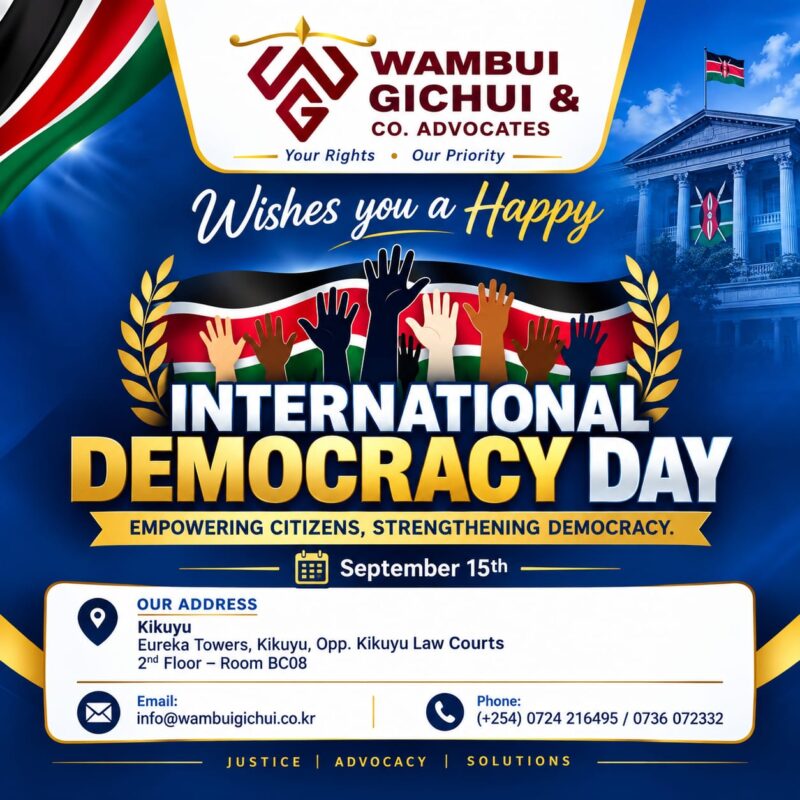
Reflecting on democracy, the rule of law, citizen participation, accountability and the protection of fundamental rights.
Every year on 15 September, the world marks the International Day of Democracy to reflect on the importance of democracy and the role of people in shaping the societies in which they live.
The International Day of Democracy originated from the Universal Declaration on Democracy, adopted by the Inter-Parliamentary Union (IPU) in September 1997.
Following subsequent international efforts to promote and consolidate democracy, the United Nations General Assembly, through Resolution 62/7 adopted on 8 November 2007, declared 15 September as the International Day of Democracy.
The first International Day of Democracy was observed in 2008, providing an annual opportunity to reflect on democratic values and institutions around the world.
The Day provides an opportunity to reflect on the principles that underpin democratic societies, including participation, equality, human rights, freedom, accountability and the rule of law.
Democracy involves more than elections. It also involves respect for fundamental rights, freedom of expression, access to information, public participation, accountable institutions and the rule of law.
Democratic governance requires public institutions and individuals to operate within the framework of the law.
Accountability helps ensure that public power is exercised responsibly and remains subject to appropriate oversight.
Citizens play an essential role in sustaining democratic societies. Their participation extends beyond voting and includes responsible engagement with public institutions and decision-making processes.
Democracy and the rule of law are not merely constitutional ideals. They are principles that can have practical implications in the everyday operation of legal and public institutions.
In a recent event in Kenya, democracy and the rule of law were demonstrated in the High Court in Katiba Institute v Attorney-General & Others (Petition No. E333 of 2026), wherein the proceedings concerned the proposed establishment of an Ebola quarantine and treatment facility.
The Court issued conservatory orders concerning the proposed facility, reflecting the role of the courts in providing oversight where the exercise of public power is challenged.
The government was required to comply with the Court’s orders.
This illustrates how the rule of law can operate as a practical mechanism for accountability and judicial oversight rather than merely remaining a constitutional principle.
Legal professionals have an important role in the realization of justice through respect for the rule of law, democratic principles, accountability and the protection of rights.
As legal practitioners, we recognize that the principles of democracy, accountability and the rule of law must be reflected in practical legal work and in the pursuit of justice.
Upholding respect for fundamental rights and freedoms.
Promoting accountability through the proper application of the law.
Supporting access to justice and fair legal processes.
Advising clients on their legal rights and responsibilities.
Respecting the rule of law in legal practice and representation.
Contributing to a fair and accountable society through legal practice.
International Day of Democracy reminds us that democracy is not limited to elections. It is also about participation, freedom, equality, accountability, human rights and the rule of law.
The practical operation of the rule of law, including through judicial oversight, demonstrates how democratic principles can influence the exercise of public power and protect the rights of individuals and communities.
Our law firm is a practical participant in respecting rights, promoting accountability and pursuing fairness and justice. We are guided by these principles in our legal practice and in our commitment to the rule of law.
Legal rights and democratic principles matter in everyday life. If you need legal advice or representation concerning your rights, public accountability or other legal matters, our team is available to assist.
Speak to Our Legal Team


